This page documents a survey of the zcar mailing list. This is an auto enthusiast list, not related in any way to synthetic oil or any oil company. (I am also not associated with an oil company or synthetic oils in any way.) I asked the following two questions of the list members:
"If you are now running synth oil, at what mileage did you switch from conventional motor oil? Do you now have oil leaks?"
I welcomed any associated anecdotal information that might come along with the data. In some cases I received only the anecdote and sent a direct follow-up email to elicit the data. In all, I got 74 individual cars (with one respondant single-handedly providing 18 of them) that were switched to synth at a specific, documentable mileage. Despite several submissions, I excluded boat and other non-car motors from the study. In some cases, the motor leaked oil both before and after the switch. For the purposes of this survey, a no-change situation was counted as a no-leak situation (the leaks did not worsen). My own car, switched a day or two before I announced the survey, has been excluded from the data sample.
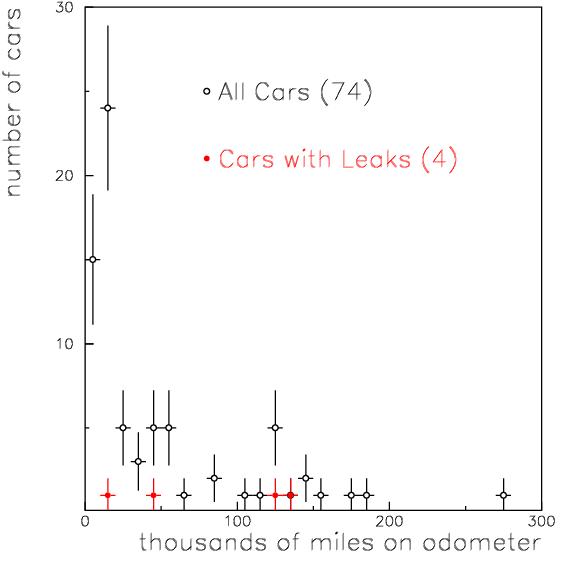
The figure displays the number of cars versus miles on the motor at the time of the switch. The black circles represent all cars, regardless of leaks or lack of leaks. The red dots indicate only vehicles that developed oil leaks after a switch to synthetic motor oil. Each data point includes the number of cars within a given mileage range; these bins all have a width of 10k miles. Note that some bins are simply empty, having no respondants in that mileage range.
If you cannot see the .jpg image, click it for a PostScript version. (I realize not many people can read .ps files, but it is what I have for now...)
Several results can be distilled from the plot. It is interesting to note that many respondants with new cars wait several thousand miles before switching their cars, as seen by the jump at the second data point. On a purely numerical basis, 5.4% of all cars switched to synth oil subseqently leaked. Because there were only four occurances of leaks, it makes sense to examine them individually.
Vehicle 1: a rebuilt engine with 10,000 miles. Per the owner, leaks occured all over: the drain plug, oil filter, valve cover, and oil pan. The problem was solved by using the appropriate wrench to tighten everything. The car still runs with synth oil, and no longer leaks. When I asked, the owner said the engine rebuild was done by his brother, a professional mechanic for 15+ years.
Vehicle 2: a 1973 240Z with 48k or so. The pivot pin in the mechanical fuel pump began leaking immediately. The pump was replaced and the car no longer leaks.
Vehicles 3 and 4: a 75 Porsche 911 with 120k miles and a Porsche 914 with 130k miles. Both motors began leaking after 150 miles with the synth oil in them and got progressively worse. Unlike the previous two vehicles, the oil leaks were not directly traceable. I found the testimonial of the owner quite interesting:
"...Biggest prob with the Porsches is that there are so bloody many seals as compared to other motors. Couple that with the split engine case design, oil coolers, the flat arrangement of the cyls, 3 oil return tubes and 12 quarts of oil with most of it laying in the engine when not running and I am surprised they don't leak like a sprinkler."But to make a short story long, this has been a complaint on the porsche list I am on."
The survey results suggest several obvious...
First, engines with few miles on them are not immune to leaks. Conversely, switching a high-mileage engine to synthetics does not guarantee oily spots in the garage. Someone comfortable with car work might be tempted to ignore some or all of the leaking engines because of their accompanying stories, but one must remember that many people are not gifted with mechanical skills and would not or could not necessary fix a car themselves once it starts leaking. More importantly, with only four failures, this study does not have enough data to draw a strong conclusion about the nature of synth oil leaks in general. The rate of occurance of leaks appears to be high enough to merit caution when switching a motor from natural oil to synthetic oil, and a general warning to those interested in switching.
Inconsistency is the nature of anecdotal information. I knew this going in, and that is one reason I insisted on numerical data from those that wanted to participate in this study. In this section I want to "give you the flavor" of the anecdotal information I collected.
In addition to the motors that started leaking as noted above, I had one claim of a motor that stopped leaking when switched to synthetic. (I should note again that in some cases above, the motor leaked oil both before and after the switch...these no-change situations were counted as no-leak situations.) I had some claims that the motor consumed less oil than it did before the switch, and several had the more-expected complaint of more oil consumption. For some, the average oil pressure went up after the switch, for some it was lower.
One need only surf a few websites to learn that modern synthetic oils contain "seal-swellers" but I was warned in a couple of cases that different seal materials would react differently to the oil additives. Some webpages tell you of additives that lower the surface tension of the oil to prevent foaming, yet other oils are supposed to be "the best" because they have the highest surface tension.
Several respondants believe that sludge in the oil pan can work loose upon the introduction of synthetic oils; huge gobs of the stuff could then plug oil lines entirely. To avoid this ugly resut, they advocate use of any of a number of engine flushing techniques right before the switch. On the other hand, the vast majority of respondants did nothing special, "just drain out the old oil, install a new filter, and put in the synth oil."
I received several reports of modest MPG gains and quieter engine running. Several people do all of their own motor work and although none of the respondants gave specifics in this regard, all seemed pleased with the "level of protection" the motor recieved from synth oil, as based on their experiences.
The last two case studies suggest that different vehicles may suffer a higher leak occurance rate than the typical cars on the Z mailing list. For personal reasons (i.e. ownership) I plan to repeat this survey on a Jeep Cherokee mailing list. These vehicles are used quite differently from the typical Z car and it may be instructive to see if synth oil behaves differently in a motor with lots of low-end power... I hope to extend the survey to a Porsche owners list also.
I did not ask about oil consumption and perhaps I should have. Many of the emails I received detailed the oil consumption before and after switching to synthetic. One could argue that oil consumption is itself a leaky motor, only leaking internally instead of externally. I will keep it in mind for a future effort.
I extend my deep thanks to the Zcar mailing list for their willingness to share their stories. Without them, I wouldn't have a study and, in retrospect, without the list I wouldn't have bought a Z.
John Krane, Ph.D.
Department of Physics and Astronomy
Iowa State University
(But based at Fermilab, near Chicago)
Please feel free to discuss this survey with anyone you like. I only ask that you do not "tip my hand" to a Jeep or Porcshe mailing list -- I don't want to bias my next survey...
Thanks again.
